Why Space Needs Storytellers
Space exploration has always captured our collective imagination. For many of us, it begins with the roar of rockets, the gleam of launch vehicles underneath the Cape Canaveral sun, and the ingenuity of the people who bring these dreams to life. The headlines love to focus on the big numbers: the distance traveled, the power harnessed, the risks faced. These are the stories that are easy to marvel at, but they’re only a microscopic part of the picture.
The story of space is not written by engineers alone. Space programs endure only when they give us something to believe in here on Earth. Political will, international partnerships, and a shared sense of purpose are as mission-critical as any rocket fuel. That’s where cultural stewards come in, in the form of storytellers, diplomats, and communicators who work hand-in-hand with the engineers and scientists who “change the possible.” They open the door to exploration, while cultural stewards help us understand why we should walk through it.
Consider the Lunar Gateway. On paper, it’s a plan straight out of science fiction: an outpost orbiting the Moon, supporting NASA’s Artemis missions to Mars. It will be a place where astronauts dock, transfer to lunar landers, and perform science investigations. Gateway’s real significance goes beyond technology. Its true power lies in its ability to bring people and nations together.
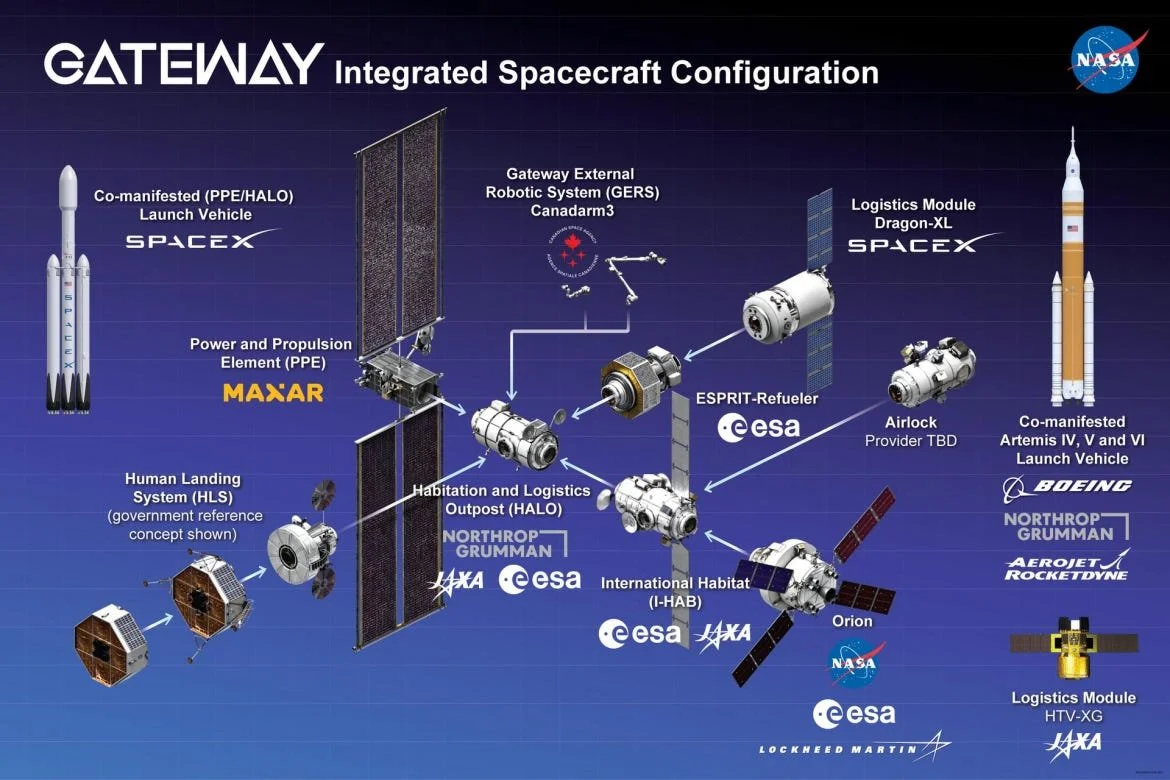
While NASA gets a lot of the credit, it’s a true team effort. Partners like the European Space Agency (ESA), Japan’s space agency (JAXA), and the Canadian Space Agency (CSA) are all in, thanks to agreements like the Artemis Accords. These agreements act as the glue that holds the global dream together. Building that kind of trust and cooperation is a human feat that takes years of conversation, negotiation, and vision. Even the most advanced parts of Gateway tell a larger story. For example, its Power and Propulsion Element will generate electricity and use solar electric engines to help the station maintain its orbit around the Moon. This is an impressive leap. Imagine a space outpost that can move itself, adjusting its orbit as needed, all while supporting a team of astronauts and experiments.
But perhaps the biggest breakthrough is what Gateway represents. By building permanent infrastructure, the United States is sending a message. We’re here to stay on the Moon, not just pay a visit every fifty years. When exploration moves from publicity stunts to building sustainable infrastructure, the questions we ask ourselves change. It’s no longer a question of “Can we get there?” but “How do we work together once we arrive?” Without science communicators, a feat like this is too abstract for many American taxpayers to believe in.
The numbers tell their own story. Around seven-in-ten Americans say they want the U.S. to lead in space, according to the Pew Research Center as of 2023, but when it comes to increasing spending, that support fades quickly. The opinions of the American people are crucial. Space is expensive, and they are left footing the bill. Public documents don’t offer a single, clear “Artemis total” for fiscal year 2026. However, the NASA Authorization Act of 2026 sets NASA’s overall budget at $24.7 billion for this year, with Artemis remaining a major line item and specifically protected from budget cuts. Earlier, the White House’s FY 2026 proposal aimed to reduce NASA’s budget by $6 billion and included plans to restructure Artemis by canceling Gateway and retiring SLS/Orion after two more flights. Congress ultimately rejected those proposed cuts, keeping Artemis on track. Projects like this need steady support, not just for a few years, but for decades.
It is imperative that these projects are enriched by public enthusiasm to survive. Without effective storytelling, the public may see Artemis, Gateway, and similar efforts as distant, leaving them vulnerable to budget cuts. Storytellers help translate the complex goals and milestones of these missions into narratives that people care about. When the public understands what is happening and why it matters, support for these projects becomes stronger and more resilient.
History has laid a precedent for what happens when this essential support disappears. After the final Apollo missions in the early 1970s, public enthusiasm declined, and Congress reduced funding. Despite extraordinary technical success, the Apollo program ended because the political narrative no longer needed it. Engineering had solved the problem of reaching the Moon. Cultural stewardship had not sustained the reason for continuing. Keeping that story alive takes people who can turn technical achievements into something meaningful for everyone. Carl Sagan is one of the most influential examples. His television series Cosmos, which won two Emmy Awards, introduced hundreds of millions of viewers to astronomy and planetary science. Sagan understood that exploration needs a cultural constituency. If people do not feel connected to space, they will not support the organizations that make exploration possible.
“Since, in the long run, every planetary society will be endangered by impacts from space, every surviving civilization is obliged to become spacefaring — not because of exploratory or romantic zeal, but for the most practical reason imaginable: staying alive.”
Inside NASA, public affairs teams take on this same role of translation. During the Apollo era, NASA communications teams ensured that the Apollo 11 Moon Landing was broadcast to an estimated 650 million people worldwide, making it one of the most-watched events in human history. The technical achievement of landing on the Moon became a shared global experience because communicators framed it as a milestone for humanity rather than an American engineering victory. Today, NASA still treats public communication as an essential component of operations. Social media broadcasts of launches, astronaut photos from orbit, and live mission briefings reach millions worldwide. These efforts help build a global audience that sees exploration as something we all share.
The same idea holds true for robotic missions, too. When Voyager 1 and 2 launched in 1977, the spacecraft carried the two identical Golden Records curated by Carl Sagan and his collaborators. The record contains music, greetings, and sounds from Earth. Instead of serving an engineering purpose, it acted as a symbolic introduction of humanity to the galaxy.
My personal favorite instance of people connecting with space objectives is the famous message from the Opportunity “Oppy” Rover. During a dust storm blustering on Mars in 2018, Oppy sent out a final reading of low-power signals. The human interpretation, “My battery is low, and it’s getting dark,” took Twitter by storm as the entire nation mourned the fallen rover. The story of Oppy serves as a case study for NASA’s brilliant science communication strategies.
The next era of exploration will involve more actors than any period in history. National agencies operate alongside private companies such as SpaceX and Blue Origin. Lunar exploration is becoming a multipolar enterprise. In this new environment, engineering alone isn’t enough. We need diplomacy to build partnerships, communication to earn public trust, and cultural interpretation to remind us why exploration matters at all.
This article was written by Kelsie Goddard, Founder and Editor-in-Chief of Spacefarer. To learn more about the Spacefarer editorial team and contributors, visit our About page.
