Space Sells: The Aesthetics of NASA's Artemis Program
One of the shining moments of America’s history as a global superpower was NASA’s successful lunar landing in 1969. Today, the Artemis program is designed to revive the emotional authority of America’s glory days of space exploration while restructuring lunar exploration for permanence, coalition building, and institutional sustainability in a political environment defined by administrative turnover. Building on the success of Artemis I, NASA’s recycling of Apollo aesthetics, its expansion into streetwear culture, and its digital framing of Artemis are not superficial branding exercises, but a deliberate political strategy on display.
Beginning with the elephant in the room, the visual parallels with the Apollo program are immediate. The Artemis “A” insignia appears across merchandise, mission patches, and social media graphics. Its sharp triangular form and sweeping trajectory line echo Apollo-era imagery. The name Artemis reinforces this connection with the same transparency. In Greek mythology, Artemis is the twin sister of Apollo. The pairing signals succession, framing Artemis as the heir to Apollo’s success and using visual callbacks to reassure Congress and the public that the program represents continuity with a national achievement.
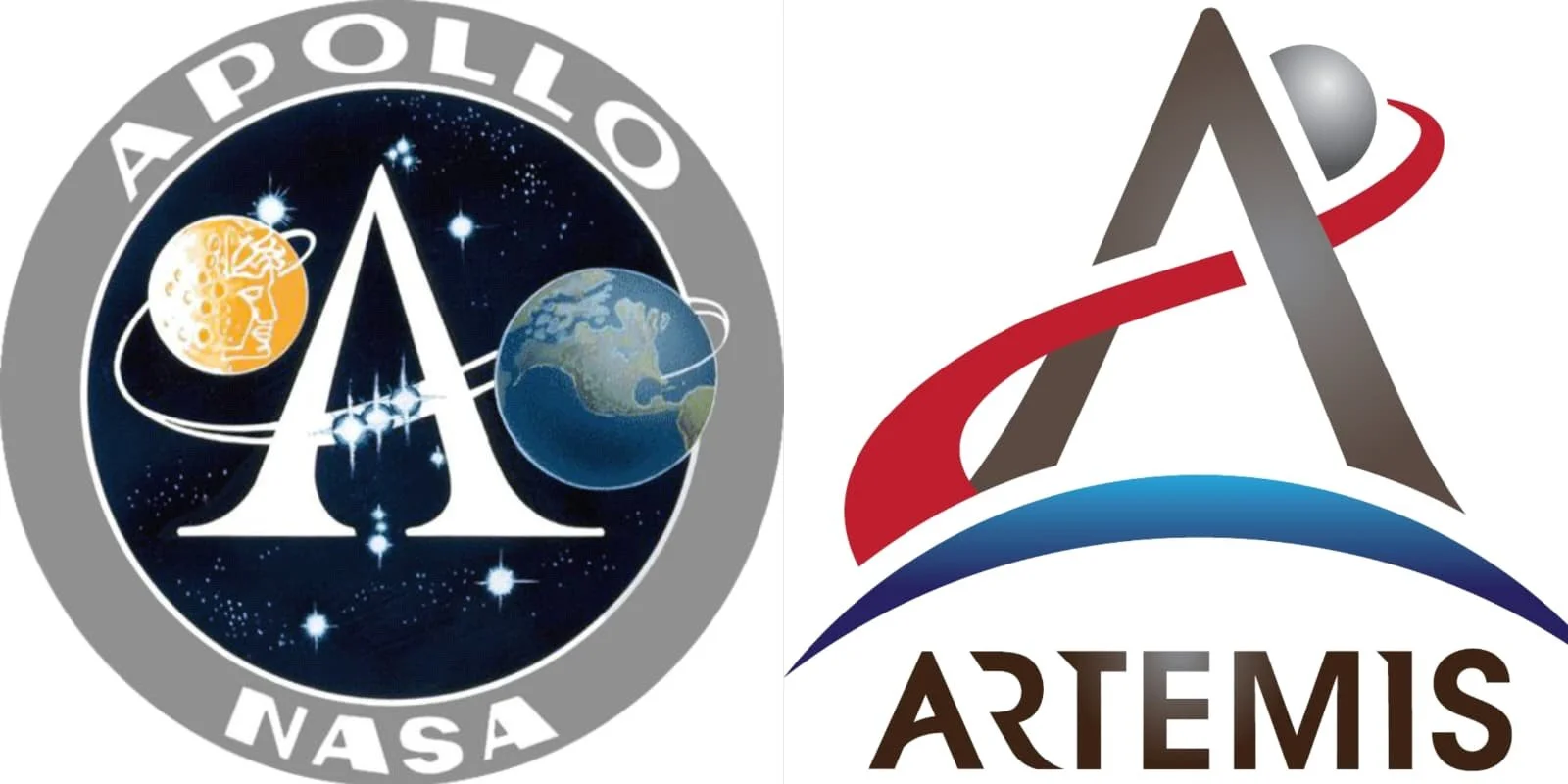
Apollo remains NASA’s most politically successful project not because of its budgetary scale, but because of its measurable durability and goal attainment. In 1961, President John F. Kennedy publicly committed the United States to landing a man on the Moon and returning him safely to Earth before the decade’s end. That objective was achieved in 1969. Few federal programs meet their stated goals on schedule under conditions of global upheaval. Apollo survived escalating Vietnam War expenditures, domestic unrest, and the Apollo 1 disaster without collapsing under the weight of national crisis. At Apollo’s peak in 1966, NASA consumed 4.41 percent of the federal budget, according to NASA’s historical budget tables, reflecting an extraordinary level of congressional prioritization. For reference, NASA hovers around 0.3 to 0.4 percent of federal spending. More importantly, Apollo institutionalized space exploration as a permanent federal function, creating procurement networks, research centers, and industrial coalitions that persist decades later. Political success, in this case, was the alignment of executive ambition, congressional funding, and ultimate delivery. No subsequent NASA initiative has combined those elements at a comparable scale.
The sequencing of missions strengthens this framing. Apollo missions were numbered, yet culturally remembered as a sprint culminating in Apollo 11. The program compressed into a climactic victory with the moon landing in 1969. Artemis is publicly staged as a process: Artemis I, II, and eventually III are scheduled for 2028. NASA emphasizes the sequence in press releases and social media. For Artemis I, NASA’s social media angle capitalized on participatory campaigns tied to mission milestones. NASA invited the public to share Moon-themed photos and art under the hashtag #NASAMoonSnap, highlighting multiple mission phases (launch, lunar orbit, return) and engaging followers across platforms beyond the single event of Artemis I’s launch. Rather than building toward a single dramatic crescendo, this approach conditions audiences to see Artemis as cumulative and ongoing. The emphasis is not on one historic moment but on a series of linked developments that construct long-term capability. While Apollo raced towards a global spectacle, Artemis is presented as a sustained progression.
While NASA’s Space Launch System (SLS) echoes the visual language of the Saturn V in its towering height, elongated core, and flanking solid boosters, these similarities stem largely from functional design requirements rather than deliberate imitation. Even so, the overall silhouette unmistakably recalls Apollo. In doing so, the rocket becomes more than a launch vehicle. It operates as a symbol of continuity, capitalizing on collective memory among the public and Congress alike. The vehicle has evolved into a brand of the mission itself, with scale models and LEGOs in its likeness, extending the program beyond policy debates into living rooms, where the rocket becomes both a nostalgic heir to Apollo and an object of childhood imagination.
Yet the campaign does not freeze itself in nostalgia. NASA has entered contemporary streetwear culture, including collaborations involving Golf Wang, founded by Tyler, the Creator. Certain pieces echo retro design cues, most notably NASA commentator Derrol Nail’s hat, worn during the splashdown of Apollo 17, which was heavily inspired by the ones that the Apollo astronauts wore. However, the shift into modern aesthetics is unmistakable across this collaboration, such as Artemis’ signature gradient colorway that represents new horizons. This color palette being present is so important to NASA’s branding of the Artemis missions that even Nail’s hat, which would otherwise be an almost faithful replica of the Apollo 17 astronaut hats, featured NASA's "Horizon" gradient. NASA identifiers may appear decoratively, but the agency cannot imply formal co-branding. As a government institution, it must avoid endorsing private companies. The imagery remains under NASA’s complete stewardship even as it borrows cultural capital. In doing so, NASA positions Artemis within contemporary youth culture without relinquishing institutional control, extending the program’s relevance beyond legacy space enthusiasts and into audiences with no lived memory of Apollo.
Streetwear itself reflects the dynamics of globalization. As social-cultural anthropologist Arjun Appadurai argues in Modernity at Large, cultural forms circulate through global media and migration flows, detaching from any single territorial origin. What began in American hip hop communities was adopted and reinterpreted abroad, from Tokyo to Seoul, and then reintroduced into Western markets in hybridized form. Streetwear today is less a national style than a transnational vocabulary, shaped by borrowing and re-borrowing across borders. By placing Artemis imagery within that aesthetic, NASA inserts its iconography into a global cultural circuit rather than a purely American one, extending relevance without surrendering institutional control. For example, if NASA were to have a similar campaign with Levi’s jeans, it would send a much different message. The choice to focus on streetwear specifically aligns with Artemis’ diplomatic framing.
Language surrounding Artemis further departs from Apollo’s Cold War rhetoric. Apollo was justified as an “urgent national need,” according to President John F. Kennedy in 1961. Artemis is framed around a sustained presence on the moon. Agency documents describe a transition from short Apollo-style visits to long-term human presence and sustained exploration on and around the Moon, supported by international and commercial partners. The Lunar Gateway is described as humanity’s first space station beyond low-Earth orbit, designed with a planned multi-year lifespan and capabilities for extended science and crewed operations, underscoring Artemis as cumulative groundwork.
This permanence is reinforced through legal architecture. The Artemis Accords, signed beginning in October 2020, formalize principles such as transparency, interoperability, and peaceful use. While Apollo planted a flag, Artemis instead signs agreements before it establishes a foothold. For instance, the Lunar Gateway relies on international contributions such as the International Habitation Module (I-Hab), an ESA-contracted component being constructed by Italian firm Thales Alenia Space in Turin, demonstrating Italy’s significant role in equipping the station that will support Artemis missions.
Commercial intermediaries now play a central role in how NASA presents the Artemis program institutionally. During the Apollo program era, NASA designed and built its own launch vehicles and lunar modules. Under Artemis, NASA contracts private companies for key mission elements and openly foregrounds those partners in its planning and contract awards. For example, NASA selected SpaceX’s Starship vehicle to serve as the human landing system under its Human Landing System (HLS) contract, a decision that includes ongoing modifications and multiple demonstration missions to support sustained lunar exploration beyond Artemis III. NASA has also awarded commercial Gateway Logistics Services contracts for cargo deliveries to the Lunar Gateway to help sustain the outpost that will support Artemis missions. By building the program with commercial partners rather than solely relying on NASA’s in-house vehicles, the agency positions itself as coordinator of a broader industrial ecosystem rather than as a solitary proprietor of exploration. That role aligns with Artemis’s diplomatic emphasis on coalition and partnership, a posture that fits more comfortably within multilateral politics than the monolithic national champion model of Apollo.
NASA’s crew selection for Artemis II highlights this shift further. NASA’s official Artemis program pages once explicitly stated that the agency planned to “land the first woman, first person of color, and first international partner astronaut on the Moon” as part of the Artemis III mission. That wording appeared on NASA’s website in a 2023 version of the program description before being removed in 2025 due to broader federal policy changes. Even so, the astronaut roster for Artemis II has its share of diversity. The four-person crew includes Christina Koch, who will become the first woman to travel beyond low Earth orbit toward the Moon; Victor Glover, who will be the first person of color assigned to a lunar mission; and Jeremy Hansen of Canada, who will be the first non-United States astronaut to fly this close to the Moon. The composition of the crew reflects how Artemis is publicly framed around representational milestones as well as technical achievement, embedding inclusion directly into the narrative of lunar return. Apollo required no demographic framing to justify itself. Artemis operates within a different political environment where representational legitimacy becomes part of the funding argument.
“The last time I sat before you, I introduced myself, my qualifications, and the challenges and opportunities ahead. This time, I’m here with a message of urgency.”
Geopolitical competition has not disappeared. China and Russia’s lunar ambitions have applied pressure on the United States, including plans to build a lunar reactor between 2033 and 2035. NASA’s target dates, such as Artemis III in 2028, reflect awareness of that timeline. During his Senate confirmation hearing, Jared Isaacman stressed the importance of returning Americans to the moon as a demonstration of continued leadership in space. His opening statement can be read as an echo of Kennedy’s call to meet an “urgent national need,” when he told the Senate that he was appearing “with a message of urgency” regarding China’s plans for the moon. Yet, even when framed in competitive terms, the broader architecture of Artemis remains coalition-oriented. The program’s structure, partnerships, and public messaging emphasize coordination with allies and commercial actors, suggesting that leadership is being defined less as solitary triumph and more as the capacity to organize and sustain a multinational lunar presence.
These elements suggest a curated blend of continuity and adaptation. Artemis draws on Apollo’s emotional capital, tapping into nostalgia to anchor public trust, while simultaneously departing from it through inclusion-centered messaging, commercial integration, and treaty-based cooperation. The architecture of the program is designed not only to reach the Moon, but to endure politically once it gets there.
Where Apollo proved that the United States could reach the Moon, Artemis is designed to prove that the United States can settle the Moon. This distinction effectively reframes the public imagination. Artemis is less about replaying 1969 and more about constructing the rules, coalitions, and infrastructure that will sustain an interplanetary future. NASA may be returning to the moon, but they are not returning to the past any time soon.
This article was written by Kelsie Goddard, Founder and Editor-in-Chief of Spacefarer. To learn more about the Spacefarer editorial team and contributors, visit our About page.
